
The major turning point in Lisbon’s urban development is almost universally considered to be the Great Lisbon Earthquake of 1755.
The 1755 Earthquake (and what came after)
-
On November 1, 1755, a massive earthquake, followed by a tsunami and fires, destroyed much of Lisbon—especially the medieval downtown (the Baixa).
-
Instead of rebuilding the city as it had been, the government—led by Marquês de Pombal—used the disaster as a chance to completely rethink urban planning.
How it changed the city
-
Modern urban planning: The Baixa was rebuilt with a regular grid layout, wide streets, and large squares—very different from the narrow, winding medieval streets.
-
Early seismic design: New “Pombaline buildings” included one of the world’s first earthquake-resistant construction systems.
-
Centralized state planning: Reconstruction was fast, standardized, and directed by the state—an early example of top-down urban modernization.
-
The turning point marks Lisbon’s shift from a medieval city to a modern planned capital.
-
The rebuilt Baixa still defines the city’s core today, both spatially and symbolically.
-
Few cities have had a single event so radically reshape their urban form.
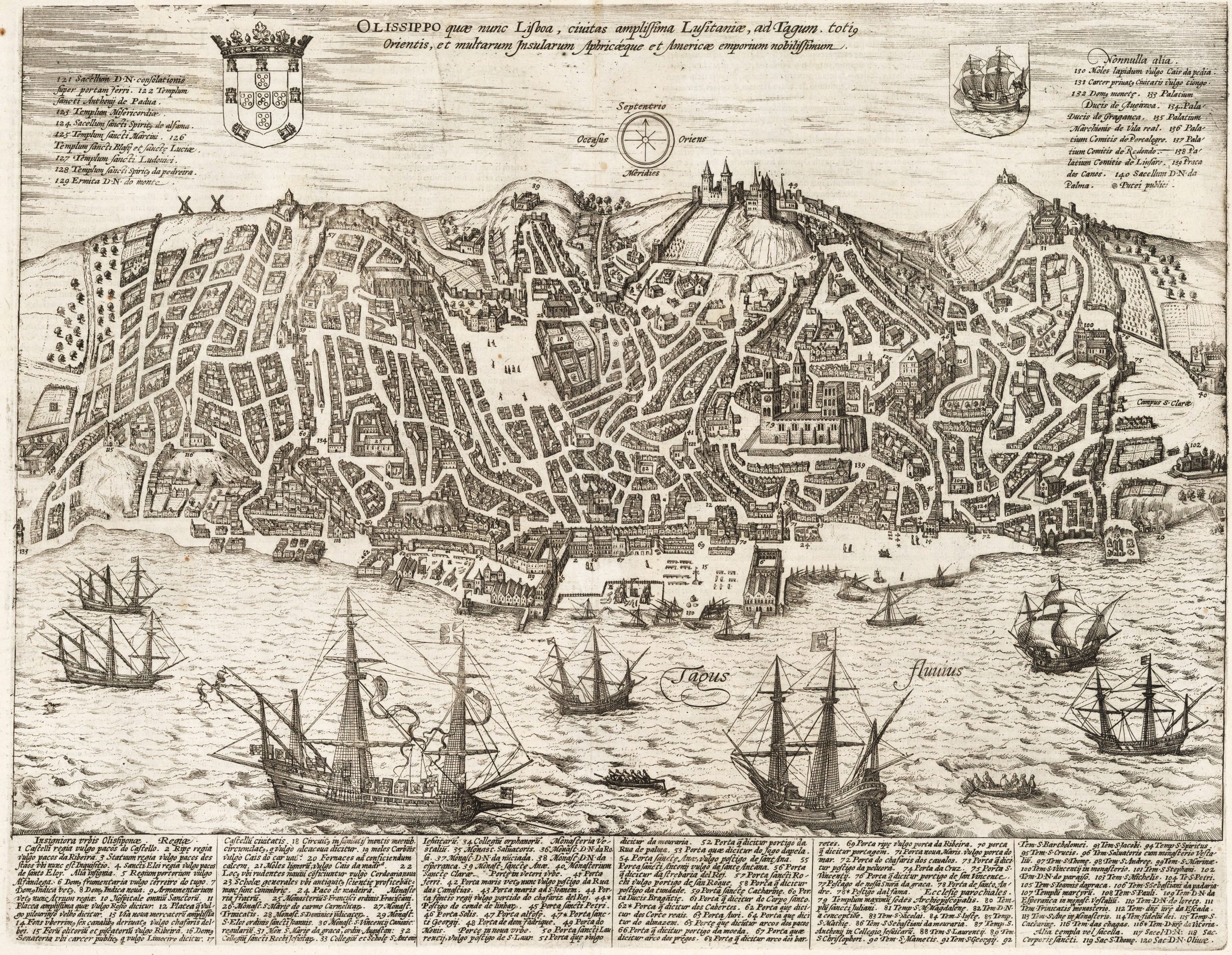
Medieval Lisbon around 1600
On 1 November 1755, the city was destroyed by another devastating earthquake, which killed an estimated 30,000 to 40,000 Lisbon residents[50] of a population estimated at between 200,000 and 275,000,[51][52] and destroyed 85 percent of the city’s structures.[53] Among several important buildings of the city, the Ribeira Palace and the Hospital Real de Todos os Santos were lost. In coastal areas, such as Peniche, situated about 80 km (50 mi) north of Lisbon, many people were killed by the following tsunami.
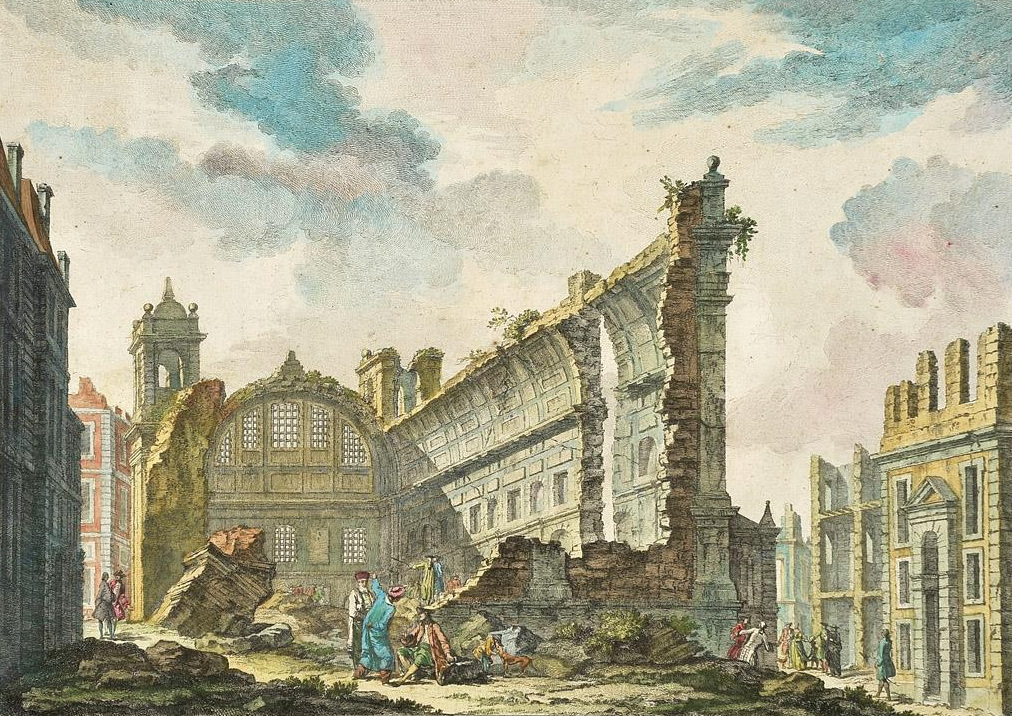
By 1755, Lisbon was one of the largest cities in Europe; the catastrophic event shocked the whole of Europe and left a deep impression on its collective psyche. Voltaire wrote a long poem, Poême sur le désastre de Lisbonne, shortly after the quake, and mentioned it in his 1759 novel Candide (indeed, many argue that this critique of optimism was inspired by that earthquake). Oliver Wendell Holmes Sr. also mentions it in his 1857 poem, The Deacon’s Masterpiece, or The Wonderful One-Hoss Shay.
Wikipedia
The 1755 Lisbon earthquake, also known as the Great Lisbon earthquake, hit Portugal, the Iberian Peninsula, and Northwest Africa on the morning of Saturday, 1 November, Feast of All Saints, at around 09:40 local time.[3] In combination with subsequent fires and a tsunami, the earthquake almost completely destroyed Lisbon and adjoining areas. Seismologists estimate the Lisbon earthquake had a magnitude of 7.7[4][5] or greater[6] on the moment magnitude scale, with its epicenter in the Atlantic Ocean about 200 km (110 nmi; 120 mi) west-southwest of Cape St. Vincent, a cape in the Algarve region, and about 290 km (160 nmi; 180 mi) southwest of Lisbon.
Chronologically, it was the third known large-scale earthquake to hit the city (following those of 1356 and 1531). Estimates place the death toll in Lisbon around 30,000–40,000. A further 10,000 may have died in Morocco.
The earthquake accentuated political tensions in Portugal and profoundly disrupted the Portuguese Empire. The event was widely discussed and dwelt upon by European Enlightenment philosophers, and inspired major developments in theodicy. As the first earthquake studied scientifically for its effects over a large area, it led to the birth of modern seismology and earthquake engineering.
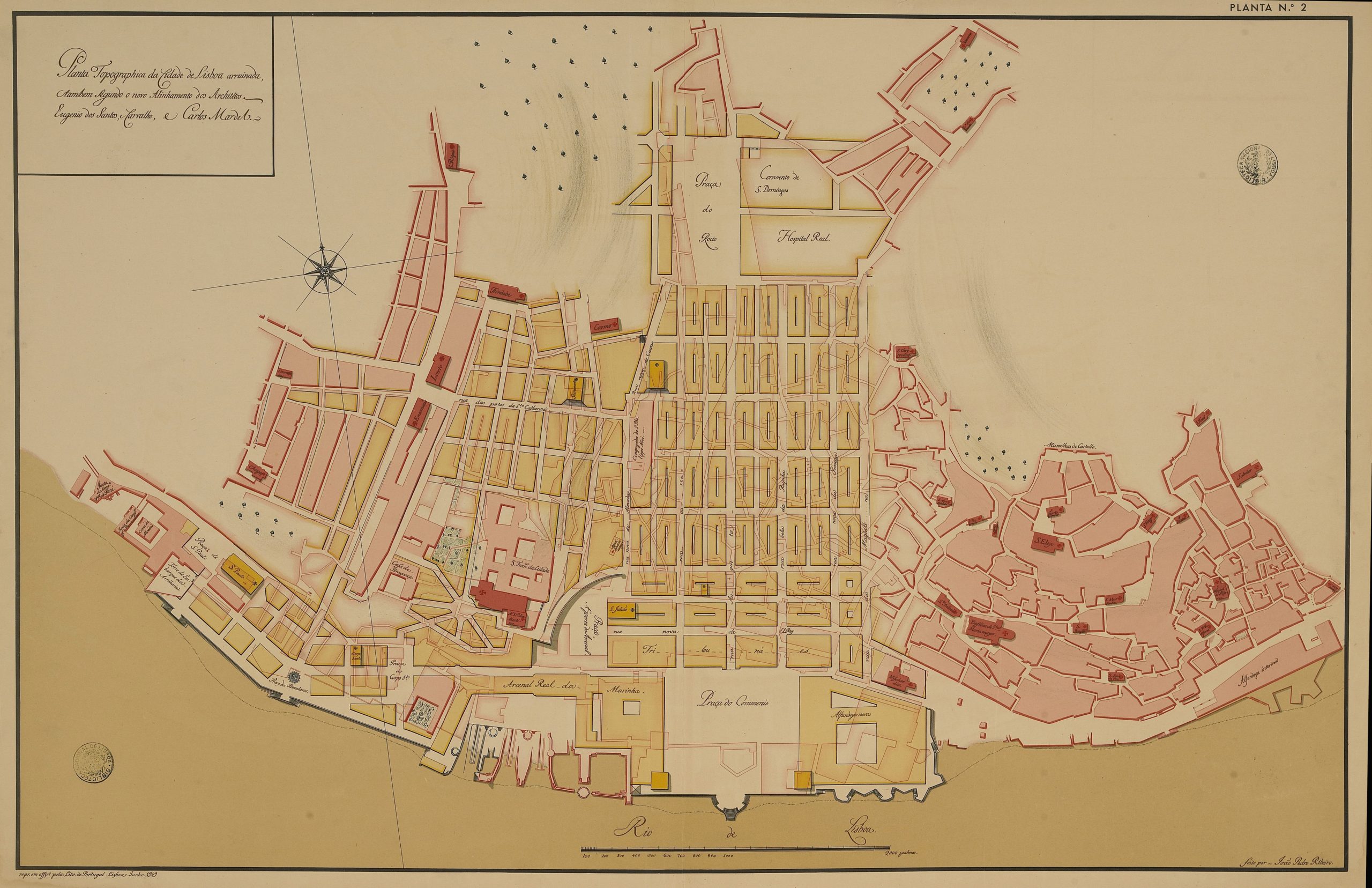
Eugénio dos Santos (1711-1760) and Carlos Mardel (1696-1763) – revistadiagonal
Pombaline Baixa, Lisbon, rebuilding plan after the 1755 earthquaque. Quelle
After the 1755 earthquake, the city was rebuilt largely according to the plans of Prime Minister Sebastião José de Carvalho e Melo, the 1st Marquis of Pombal; the lower town began to be known as the Baixa Pombalina (Pombaline central district). Instead of rebuilding the medieval town, Pombal decided to demolish what remained after the earthquake and rebuild the city centre in accordance with principles of modern urban design. It was reconstructed in an open rectangular plan with two great squares: the Praça do Rossio and the Praça do Comércio. The first, the central commercial district, is the traditional gathering place of the city and the location of the older cafés, theatres and restaurants; the second became the city’s main access to the River Tagus and point of departure and arrival for seagoing vessels, adorned by a triumphal arch (1873) and a monument to King Joseph I.